HCS Members’ Update May 2026
Members Newsletter. May 2026.
Contents
1. Castle Hill. What’s happened? What’s next?
2. Huddersfield Open Market. Plans are approved.
3. Hillhouse Coal Chutes. Delivering coal via the tram network.
4. BT Street Hubs. BT has applied to install seven.
5. Kirklees Local Plan. What is it and when will we see it?
6. Dates for your diary. Visits and events for HCS members and others.
1. Castle Hill. What’s happened? And what’s next?
Mike Woodward, HCS Committee Member.
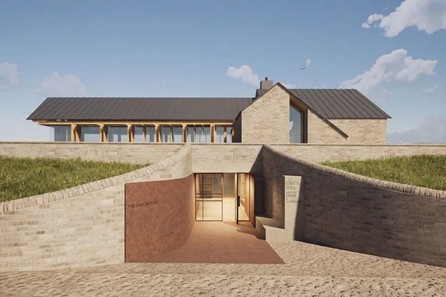
Kirklees Council Strategic Planning Committee approved plans for building on Castle Hill at a meeting on 19 February. The building, on three levels, with a restaurant/café/bar, six bed ooms, exhibition and interpretation room, WC and terrace. It was a close vote. The six councillors were split, and the vote was tied at 3-3. Approval went through on the casting vote of Labour councillor and committee chairman Cllr James Homewood. Cllr Cathy Scott (Community Alliance) proposed approval, seconded by Labour’s Mohan Sokhal. Cllr Andrew Pinnock (Lib Dem), Cllr Susan Lee-Richards (Green) and Cllr Bill Armer (Conservative) all voted against. The seventh member of the planning committee, Tory councillor Mark Thompson, did not attend the meeting.
The application was submitted by The Thandi Partnership and also includes a 41-space car park. Council Officers recommended approval saying weight must be given to the fact permission had been granted previously. They admitted that harm would be caused to the ancient site, which is within the Green Belt and includes the listed Victoria Tower. But they claimed it would be outweighed by the “public benefit” of an interpretation room and free public toilets. Nick Hirst, Planning Team Leader, admitted “public benefit” was a “judgement call” and others may take a different view.
Many spoke against the application at the meeting. Notably, a statement was read out on behalf of Poet Laureate Simon Armitage, a Freeman of Kirklees, who described building on “Huddersfield’s most famous location” as “incongruous and unnecessary.” He added: “Castle Hill is iconic. Its tower is a proud, reassuring beacon above the valleys below. The hill silhouette is etched into our subconscious as a mark of identity. He continued, “In an era where there is so much natural landscape being degenerated, exploited and made private, this is a site that should be treasured, preserved as free and public land, and maintained for its original characteristics.”. Addressing those making the decision he added “As a forward-thinking council, Kirklees should do everything they can to uphold the integrity and the dignity of Castle Hill and act as guardians of one of the nation’s semi sacred hilltop locations.”
Since the decision was made Huddersfield and District Archaeological Society has issued a strongly worded statement. It points out that “the history and archaeology of Castle Hill spans millennia” going back as far as 5000BC. “It has been suggested that the site was in use during the Neolithic and Bronze Age.” The Society quotes Historic England who, as recently as early 2025, stated that “The closest parallel for its landscape impact and iconic status is Glastonbury Tor, Somerset. The continuity of its use from as early as the Late Neolithic period has given it an almost unique standing … in the whole of the north of England. Its form as a planned medieval hilltop settlement (is) something that is unique in England”. HE recommended refusing the application in March 2025.
The comparison to Glastonbury Tor is striking. It also leads to an inevitable question. Would the local authority in Somerset entertain an application to build on that site?
But in August 2025 Historic England’s view changed. In a letter to Kirklees, Andrew Burn, development advice team leader at HE, says: “The updated documentation submitted presents a much clearer vision for the operation of the site and what public benefits will be secured from the development and, crucially, how they will be implemented. On this basis, Historic England does not object to the proposals. However, we strongly advise that your authority commissions an independent viability review of the business plan to ensure the proposed benefits can be realised.”
In changing its position Historic England has made a striking U-turn. Huddersfield Archaeological Society stated “We were shocked”. It went on to say “We are fearful that this is the thin edge of the wedge for the care of our wider heritage in England and that other monuments could also be at risk of inappropriate development.”
Though council officers recommended approving the application they also proposed operational restrictions. The restaurant is initially limited to 70 covers and must close by 11pm. Earlier proposals had suggested 100 covers. Nor shall it be used for wedding receptions or other functions without the prior written approval of the council.
Huddersfield Civic Society is one of many local and national organisations that have consistently opposed developments on Castle Hill. In autumn 2025 HCS wrote to Historic England, querying the reasoning for its about turn and whether it was correct for the organisation to now support admitted heritage “harms”, particularly if this hinged on the applicant’s ability to make sufficient money. In their response HE declined to engage in discussion on a specific case.
Castle Hill. What’s next?
The planning approval given in February doesn’t mean that development can commence. At least not for a while. It is contingent on many conditions. Councillors have opted to delegate consideration of these to the council’s head of planning.
Historic England has stated that The Thandi Partnership has yet to submit an application for Scheduled Monument Consent, required before the development can start. It must be submitted to HE itself. It is in addition to obtaining planning permission from the council. But the fact that HE has now said it believes the harm done to the site will be outweighed by public benefits may suggest a willingness to grant consent.
One condition concerns the applicant’s business case. It underpins the entire proposal. The claimed ’benefits’ of the interpretation centre and free public toilets can only be sustained by a viable business. Historic England insisted Kirklees Council commission an independent report of the Thandi Partnership’s business plan with the Thandi’s meeting the cost. Wheawill & Sudworth, Chartered Accountants, completed this task. The supporting evidence to the application includes a five-page statement from them with some figures redacted. It is dated November 2025 and refers to further details held in multiple appendixes to a full report. Neither the full report nor the appendixes are provided and don’t appear to be in the public domain. This is surely unsatisfactory given the importance attached to the business case by Historic England and the strong public interest in the site. The information provided does state that “the restaurant/bar generates the bulk of the turnover and profit for the private sector part of the project.” It also notes that “certain risks and uncertainties exist” mentioning the “general viability of entities operating in the leisure and hospitality sectors”. It recommends the Council require the Thandis to “provide periodic updates on sourcing of finance to demonstrate that adequate funding will be available” along with “refreshed financial forecasts in November 2026 to reflect any changes in the business plan.” What are we to understand by the term ‘periodic updates?
The reference here to “the private sector part of the project” is a reminder that the developers are proposing that the new establishment will be operated, at least partly, by a CIC or Community Interest Company. It isn’t clear from the documents submitted what the scope and limitations of the CIC will be. Will it be solely responsible for the Interpretation Centre and the WCs? How will it be funded? Who will be a member of the CIC?
Many concerns were submitted about difficulties accessing the site, particularly for larger vehicles and by increased numbers of cars. The road up to Castle Hill is single track and there have been some serious accidents in recent years. The developer is proposing to construct three passing places on the hilltop access road. They will need to formally describe what is proposed and this will be published on the Council’s planning database. At the time of writing, no such application has been published. Presumably the developer will meet all the initial costs? But will the council have to meet ongoing maintenance costs?
Perhaps it is naïve to think from this point everything will be left in the hands of council officers on this most controversial of decisions. After all, Kirklees Council operates with an Overview and Scrutiny Management Committee. The Council website describes the role of this committee as ensuring “that the Council’s decision making is transparent, accountable and open, bringing a different perspective to the table and giving the opportunity for a broader range of members to make a contribution to the work of the Council. It provides a ‘check and balance’ to the work of the Cabinet.” In other words, a conditional decision could be called in and looked at again by councillors.
At the time of writing all is quiet within Kirklees Council as it postpones making new policy decisions ahead of the biggest local government elections in years. On Thursday 7 May all 69 councillors in Kirklees are up for election. This is unusual. In most council elections we are only asked to vote for 23 councillors or one-third of the council. On this occasion, because the ward boundaries have changed, we are being asked to vote on every one 69 council seats. People can speak to prospective candidates or email them. Perhaps some may want to ask if candidates support or oppose the permission already granted to build on Castle Hill. Who can tell what the council may look like after these elections? Who know what changes will be made? Who knows which decisions, particularly those not yet finalised because they are contingent on conditions attached, may be looked at again?
2. Plans for Huddersfield Open Market are approved.
Mike Woodward, HCS Committee Member
On 16 April councillors approved a £16.5 million re-development of Huddersfield Open Market. The funding is provided by central government in the form of a grant. At an earlier meeting in January a decision was differed over concerns about insufficient consultation with traders. But at the most recent meeting councillors voted 5-3 in favour of the plans.
Market traders remain concerned. They argue that all that was required for the Grade 2* listed building was ‘repair and renovation’ rather than the 18-month closure and a move to a temporary market in nearby Brook Street. Traders voiced concerns about the viability of their businesses given the disruption that will be caused by the lengthy closure.
Adele Poppleton, the council’s Service Director for Culture and Visitor Economy, said the plans were about securing the long-term future of the market. She said it was a “carefully considered regeneration” that was also about “developing a financially sustainable operation.” She added: “At the moment, the market is making a loss. Without the changes we are proposing, there is a risk that the market may need to close if the council cannot continue to subsidise it. The re-development is critical to the market’s ability to diversify its offer and to operate over more hours, helping to increase footfall, improve financial sustainability, and better meet the needs of customers, residents and visitors.”
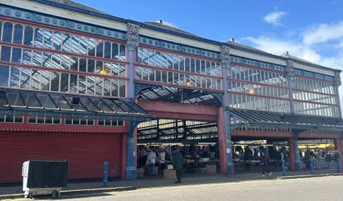
The re-developed market will see the trading floor increase in size although the number of stalls will reduce from 126 to 87. Glazing will be added to the sides of the market to keep it warmer inside. There will be a new café and a new bar. Seating will be provided on a mezzanine level providing a view of the market from above. Contractors will undertake work on the roof with builders saying that it wouldn’t be possible to undertake this safely if the market remained in use.
3. Hillhouse Coal Chutes: A Unique Survival of Transport History
Paul Jackson, HCS Member
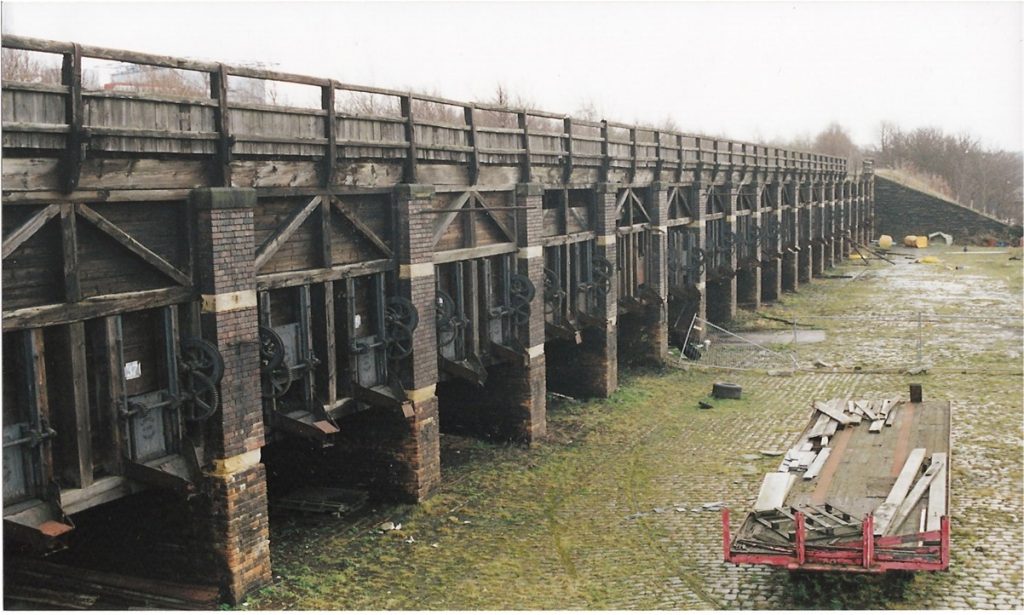
Alongside Alder Street in Hillhouse lies one of the most important surviving examples of railway industrial archaeology in the UK: the Hillhouse Coal Hoppers and Chutes. Built around 1890–1900 by the London and North Western Railway (LNWR), the site formed part of the Hillhouse sidings and locomotive depot and was used to distribute coal to Huddersfield’s industries and homes from the early 1900s until the 1970s.
The site consists of a continuous bank of 40 coal hoppers and chutes. Coal was delivered by rail along high-level tracks and discharged directly into the hoppers. Below, it was released through metal doors, operated manually by chains and geared mechanisms manufactured by S. Wright & Sons of Low Moor, into waiting carts and wagons. Many of these mechanisms still survive.
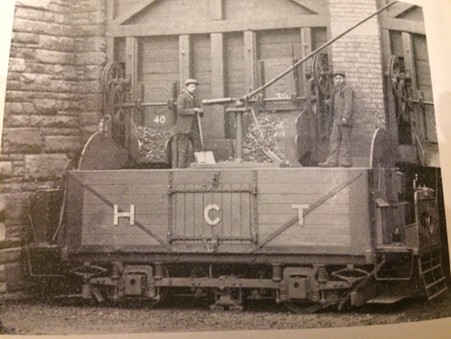
The site is uniquely significant due to its connection with an innovative municipal transport system. In 1905, Huddersfield Corporation Tramways introduced an electric coal delivery service. Two 10-ton electric coal trams operated from tracks laid alongside the chutes, connecting to the town’s tramway network. Agreements with local textile mills—including Wellington, Oakes, and Gosport—allowed coal to be delivered directly into mill yards via tramway sidings.
The service began in September 1905 and proved highly successful, delivering around 9,500 tons of coal within its first five months. It continued until 1936, when the Outlane tram route closed. Although the mills and their unloading facilities have since been demolished, the Hillhouse Coal Chutes remain as the last surviving evidence of this unique system.
The site is believed to be the longest continuous set of intact railway coal chutes in the UK and the only known location associated with electric tram-based coal distribution. It also retains surviving tramway infrastructure, including track within the yard and beneath Whitestone Lane. The tramway gauge used (4 ft 7¾ in) was itself rare in the UK.
A coal tram at Hillhouse in 1908. Picture credit HCT from book ‘Huddersfield Corporation Tramways’ by Roy Brookes
Recognising its importance, the site was awarded Grade II listed status in April 2003. Despite this protection, its condition has significantly deteriorated. Many of the wooden frames supporting the chute mechanisms have rotted, causing widespread collapse. By 2026, more than half the mechanisms had failed, with many others at risk. Vegetation growth is further damaging the structure, and parts of the yard remain in commercial use.
Without urgent conservation, this nationally significant and unique heritage site is at risk of being lost within the next few years.
4. BT street hubs. Coming to a street near you?
Mike Woodward, HCS Committee Member
BT has submitted an application to install seven ‘BT street hubs’: six in the town centre, including in conservation areas, and one on Westbourne Road in Marsh. A previous attempt by BT to install six in the town centre was rejected by Kirklees Council early in 2023.
The street hubs will replace outdated telephone kiosks. BT claims the key ‘selling point’ for the hubs is that they offer free Wi-Fi and also a telephone that can be used for making free emergency calls.
Additionally, each hub will house two 75-inch illuminated advertisement screens. The screens are the brightest and most prominent feature. They will display scrolling advertisements. BT claims that the advertisements pay for the benefits of free Wi-Fi and an emergency phone.
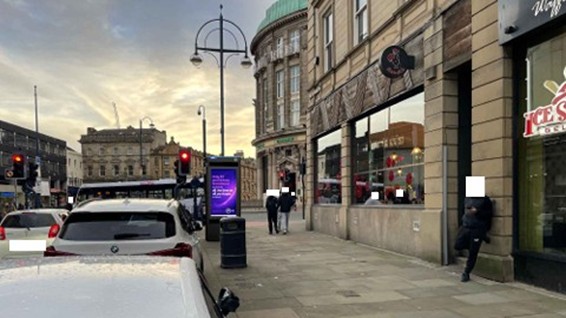
Artists impression of new BT Street Hub in Huddersfield is taken from the planning application submitted on behalf of BT
The Civic Society has objected to the applications. It feels that that the 75-inch-high advertisement screens will create unnecessary clutter in town centre conservation areas. If sited next to a busy road, as proposed in Marsh, they will not only add to street clutter but also create a distraction for road users
HCS understands and supports the need to progress from the current outdated phone kiosks as well as providing the public with modern communication options such as emergency phone and public Wi-Fi. But surely it is possible for these facilities to be provided without the overly bright and gaudy screens with the continually changing advertisements?
BT additionally claim the hubs can house sensors that might count pedestrian, cyclist and vehicle movements as well as monitor air, sound and light. The information gathered could help the local council proactively manage an area.
5. Kirklees’ update to its Local Plan has been delayed – does this matter?
Geoff Hughes, HCS Secretary
On 26 March 2026 Kirklees Council issued ‘notice to start its Local Plan under new requirements’. This contained a timetable for producing its new Local Plan, now to be ready for public consultation in June 2027. This follows recent government guidance intending to speed up the production of such plans. What it didn’t state was that this is a delay of nearly two years on the original timetable the Council had announced in March 2024 that had committed to reach public consultation in September 2025!
What does this mean? Why has this happened? Is it important?
What follows is my personal attempt to answer these questions.
Firstly, what is a Local Plan? One definition is “a statutory, community-influenced document produced by a council that sets out the long-term vision and policies for future development, typically spanning 15–20 years. It acts as the primary framework for making planning decisions, identifying where new homes, jobs, and infrastructure will go”. The latest Kirklees Local Plan was formally adopted on 27 February 2019.
A Local Plan should be reviewed every 5 years. A read now shows how things change over time, eg the section of the 2019 Plan on town centres is based upon the primacy of supporting retail needs. It is worth noting that if parts of a plan are found not to have kept pace with subsequent changes in national legislation, an interested party can successfully challenge the legality of the relevant aspects of an existing local plan, such as restrictions on where housing, factories or warehouses can be built. HCS has seen that the threat, or even just the possibility, of a challenge can be enough to make either Planners or Councillors accept a controversial development or decline to enforce an existing Local Plan rule.
Following various issues that had developed regarding the 2019 plan, Kirklees Council announced on 22 November 2023 an intention to review its Local Plan, an intention made good by a formal plan development timetable adopted in March 2024.
What changed after this?
In 2025 a new government came to power, committed to building more houses and to achieve this by mandating each local authority, to deliver these by allocating much more land for housing in its local plan. It also announced its intention to make substantial changes to many aspects of the planning system, with an overall objective of making all planning decisions, including the development of Local Plans, happen more quickly. Whilst many of the detailed proposals have recently completed consultations, and may yet become legislation in a future session of this parliament, the revised rules on how Local Plans must be produced have now come into effect. Hence the 26 March 2026 Kirklees Council announcement.
The good news is that the work by Kirklees Council’s Local Plan development team since 2023 has not all gone to waste and HCS has been assured that much can still be used. However, the ‘goalposts’ have indeed been moved and a few extra ‘rules’ have been introduced, such as requiring – in our case – more elements being developed and agreed jointly with the other West Yorkshire local authorities. The referee, sorry the government, has also introduced some additional checks into the process so that it can confirm that all the rules are being followed. Hence the March statement includes ‘The Council will prepare and publish a self-assessment summary of their readiness to deliver its Local Plan and submit it (to government) by October 2026’.
So far then, some might argue that the government’s new process to quicken the process of producing Local Plans has slowed down Kirklees’ attempt by 21 months. One could even suggest that the Ministry of Housing, Communities and Local Government might not be fully resourced and able to rapidly review and agree new submissions by many local authorities in time for Kirklees Council’s own plan to be approved to then continue to the revised schedule.
Does this matter?
Currently, house-building firms are announcing nationwide cutbacks to their house building plans and there are, sadly, few industries wishing to build or extend premises locally. Hence, whilst HCS continues to see attempts to push the boundaries of the current Local Plan land allocation and planning policy rules, there don’t appear to currently be any major developments in Huddersfield testing the validity of the existing, ie 2019, Local Plan itself.
But what will happen when economic opportunities become more favourable in Huddersfield? In Wakefield district there have already been controversial proposals for a large solar farm in greenbelt, which national planning objectives support ahead of any local concerns re agricultural, landscape or amenity matters…. This is not to argue against any such development but to hope that local people in Kirklees, and their elected councillors, will have the tools – in the form of an up-to-date Local Plan – to help ensure that developments take place where, when and in the way that the local community agrees. What might be the position in future if the proponent of a ‘Castle Hill’ or other inappropriate development is able to quote national legislation in their favour and there isn’t yet an up-to-date sound Kirklees Local Plan in place? Maybe not yet, but what if in 2027? or in 2028? …..in 2029?
In conclusion, I suggest we may yet see significant consequences from the current Local Plan delays. Whilst we cannot influence wider matters, HCS will ensure it is ready to be involved when the public consultation on the revised Kirklees Local Plan starts, which we very much hope will indeed be in June 2027. We hope HCS members will also look at the proposals next year and contribute their individual feedback.
6. Dates for your diary
Sunday 10 May 1:30pm to 2:30pm. A guided tour of Rochdale Town Hall.
This event is now fully booked.
Tuesday 30 June at 2.30 pm. Visit to the Portland Works in Sheffield. Referred to as the birthplace of stainless-steel cutlery manufacturing. It was built in Sheffield in 1879 and is now one of the last remaining working examples of a purpose-built metal trades factory. Following a half-century of neglect, the building was purchased in 2013 by a social enterprise comprising more than 500 community shareholders who, having saved it from residential conversion, are now undertaking an extensive renovation.
The grade 2* listed building has been reborn as a centre for small manufacturing, independent artists and craftspeople, with many small businesses now based within the 2600 square metre floor space. These include knife makers, an engraver and several engineers; cabinetmakers and joiners; jewellers and silver platers; artists; rug and guitar makers; photographers, a Yorkshire based gin distillery and even a high-tech CNC manufacturing site.
There is usually a tour around the yard and into a couple of workshops (depending what is open on the day). A volunteer historian will hopefully be available to answer any questions. The tour lasts approximately 2 hours and we can only take up to 20 people.
It is a busy working site and the tour is mostly outdoors around the yards, so sensible footwear is best. There are lots of stone and metal steps (no lifts) and the opportunity to go up onto the flat roof. The site is not massively accessible so if anyone requires help and cannot manage the steps please do contact Sylvia Johnson as below, so we can take advice.
For more information please go to https://www.portlandworks.co.uk/visiting-portland-works/
To book a place please email Sylvia Johnson on The cost is £5 for members and £7 for non-members. Could you please pay by bank transfer to Huddersfield Civic Society, Sort Code: 20-43-04, Account no. 50525022. Please use your surname and “Portland” as a reference please.
Tuesday July 7 from 7pm to 9pm. A walk to see Arts and Crafts houses in Huddersfield. There are still a few places left to join HCS in the company of local historian David Griffiths, author of the recent book Huddersfield’s Arts & Crafts Houses: From Edgar Wood to the 1930s, for a Civic Society guided summer evening walk around our town’s richest area of such housing in the Lindley and upper Birkby district.
Meet at 7pm at Briarcourt, 28 Occupation Road (approximately 200 metres from Lindley Clock Tower), assembling in the front garden. There are pubs but no public toilets near the start. The walk will cover a range of pavements, paths and several road crossings. There is planned to be at least one pleasant surprise en route.
Finish around 9pm having returned up Daisy Lea Lane towards the recreation ground and Lindley Clock Tower.
We have a total of 20 places available for a tour on a first-come, first-served basis. The walk is free for HCS members; £5 for non-members. To book your place, please email Geoff Hughes ”
Friday 14 August at 10am. A visit to the Bronte birthplace in Thornton, near Bradford.
Meet at the venue at 10.00 am for a guided visit of the house, followed by tea/coffee and cake. The entire ground floor of the property is accessible by wheelchair and there are accessible bathroom facilities. For those unable to ascend to the second floor, the guide can offer some time with a virtual 3D tour. Home – Brontë Birthplace
At around 11:45 we will do a short walk to the historic Bell Chapel (information at Welcome to the Bronte Bell Chapel Homepage ) The tour will end at approximately 1215/1230. If anyone wants to then do a longer walk after lunch perhaps there is the famous Viaduct Walk.
The cost including refreshments is £24 per person. (The Civic Society is not adding on any extra to the amount charged by the venue.)
To reserve a place please email Sylvia Johnson on
Regular guided walks with Discover Huddersfield. A programme of 14 guided walks through Spring and Summer starting in Marsden on Sunday 26 April at 2:30pm. Experience some of the wondrous sites and heritage of Huddersfield town centre and surrounding areas. This is a varied programme of walks continuing until October.
Walks usually last between 90 minutes and two hours and cost £5 per person. All walks must be pre-booked and bookings can be made up to 14 days before each walk. Some free walks are included as part Heritage Open Day events in September.
For Further details about the walks and how to book see https://discoverhuddersfield.uk/walks/
Details about the walks can also be accessed via the HCS website
We’d love to know what our members think about our activities, the newsletter, our events … and in particular your views on what is happening to your town … good and bad.
Let us know what you think at:
Visit us at www.huddersfieldcivicsociety.org.uk
Contact us at
We also have presence on: Facebook, Instagram and X (Twitter).